Q12Software Engineering
Question
Explain Software Development life cycle model with appropriate diagram.
Answer
A comprehensive exploration of the Software Development Life Cycle (SDLC), detailing its strict sequential phases (Requirements, Design, Implementation, Testing, Maintenance) using the foundational Waterfall Model architecture.
The Software Development Life Cycle (SDLC) is a highly rigorous, structured engineering framework utilized by massive development organizations to design, build, test, and mathematically deploy high-quality software systems. The SDLC absolutely refuses to allow chaotic, ad-hoc "hacking." Instead, it violently enforces a strict, step-by-step mathematical methodology to ensure the final product meets all critical business constraints (budget, timeline, and absolute reliability). While many specific SDLC models exist (Agile, Spiral), the foundational architecture is best explained via the classic Waterfall Model.
The Core Phases of the SDLC
Every single professional software project must pass through these explicit, irreversible phases:
- 1. Requirement Gathering and Analysis: This is the absolute most critical phase. If this fails, the entire project fails. Business Analysts aggressively interview the client to mathematically extract every single functional and non-functional requirement. This phase culminates in the creation of the Software Requirements Specification (SRS) document, a legally binding contract defining exactly what the system will do.
- 2. System and Software Design: The engineering architects take the SRS and begin generating the physical blueprints. They define the massive hardware architecture, the database schemas, the network protocols, and the exact algorithms. This phase generates the High-Level Design (HLD) and Low-Level Design (LLD) documents. No actual code is written here.
- 3. Implementation (Coding): The massive development team takes the LLD blueprints and finally begins translating the mathematical logic into raw, executable source code (e.g., C++, Java, Python). This is the longest phase of the cycle. Code must strictly adhere to organizational syntax and security standards.
- 4. Testing and Integration: Once the code is written, it is violently attacked by the Quality Assurance (QA) team. They execute Unit Testing (testing individual functions), Integration Testing (testing how modules interact), and System Testing (testing the entire software against the original SRS). Every single bug must be mathematically logged, sent back to developers, and re-tested until the software is completely bulletproof.
- 5. Deployment: The software is physically installed on the client's production servers. This often involves migrating massive amounts of legacy data, training the end-users, and performing User Acceptance Testing (UAT).
- 6. Maintenance: The absolute longest and most expensive phase of a software's life. As the business environment changes, the software must be continuously updated (Adaptive Maintenance), bugs discovered by users must be patched (Corrective Maintenance), and performance must be optimized (Perfective Maintenance).
Diagrammatic Representation
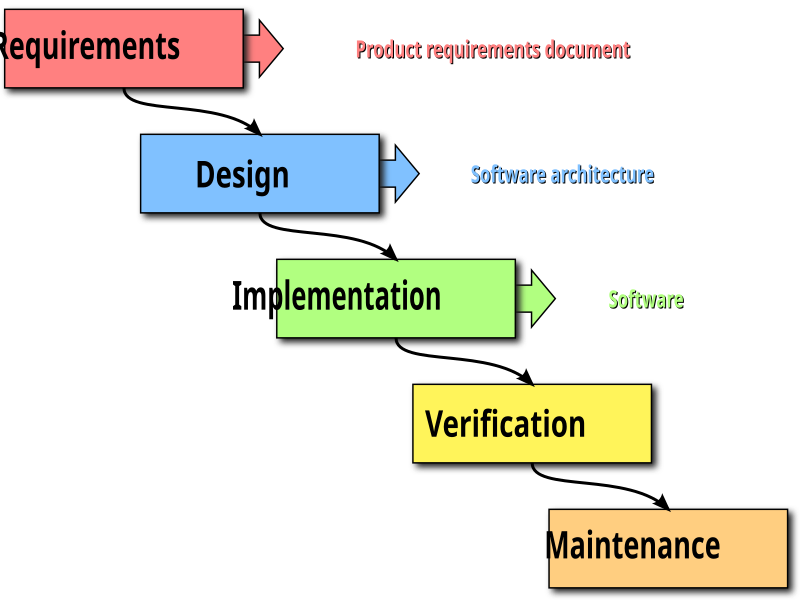
In the classic Waterfall architecture, each phase must completely finish and produce a rigid document before the absolute next phase can begin. Water strictly flows downwards; you cannot mathematically return to the Design phase once Coding has begun without destroying the project timeline.